Diminishing Returns Law
September 2026 – Vladislav KruglikovThe law of diminishing returns describes what happens when one input keeps increasing while other inputs stay fixed. At first, each additional unit of input may produce more output than the last. Eventually, the additional output from each new unit becomes smaller.
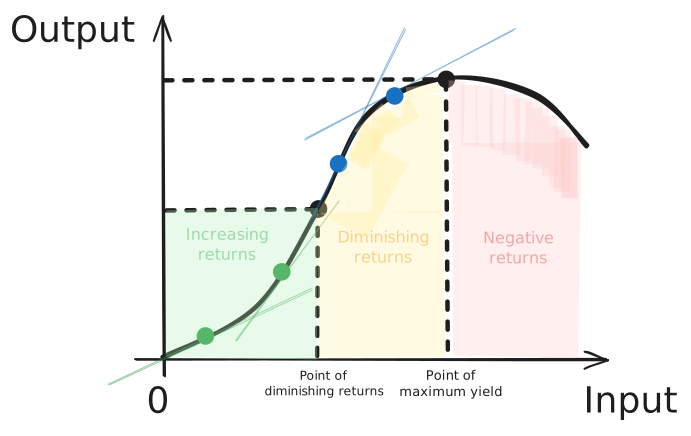
Before the diminishing-returns point
Choose any two points before the diminishing-returns point. One is to the left and the other is to the right. The point on the right has a higher rate of increase. In other words, its tangent has a larger slope, so its derivative is higher.
Starting from that right-hand point, the same increase in input produces more additional output than it would from the point on the left. This is increasing returns.
After the diminishing-returns point
Now choose two points after the diminishing-returns point but before negative returns begin. Again, one point is to the left and the other is to the right. The point on the right has a lower rate of increase. Drawing tangents makes this visible: the tangent on the right is flatter.
The output is still increasing, but the same input increase now produces less additional output from the right-hand point than from the left-hand point. These are diminishing returns. When the slope becomes negative, extra input reduces output instead of increasing it.
Why diminishing returns happen
Diminishing returns arise because resources do not scale perfectly. Consider how much useful work a person can do in a study session. Learning is not linear. An additional hour at the beginning of a session can be productive, while after ten hours it may produce only a small fraction of the earlier benefit. At that point, it can be better to stop, rest, or switch to another activity where the marginal return is higher.
The law of diminishing returns
The law of diminishing returns is the general principle that, when one input keeps increasing while other inputs are held fixed, marginal output eventually decreases. The diminishing-returns point is where each additional input stops producing larger gains and starts producing smaller, though still potentially positive, gains.